Place de la fasciathérapie dans la prise en charge de la lombalgie commune en masso-kinésithérapie : enquête de pratique auprès d’une population de masseurs-kinésithérapeutes.
Cette étude a été présentée sous forme de poster au 10e congrès international de la lombalgie et des douleurs pelviennes à Anvers. Vous trouverez un résumé en français ainsi que l’abstract présenté et retenu par le comité scientifique.
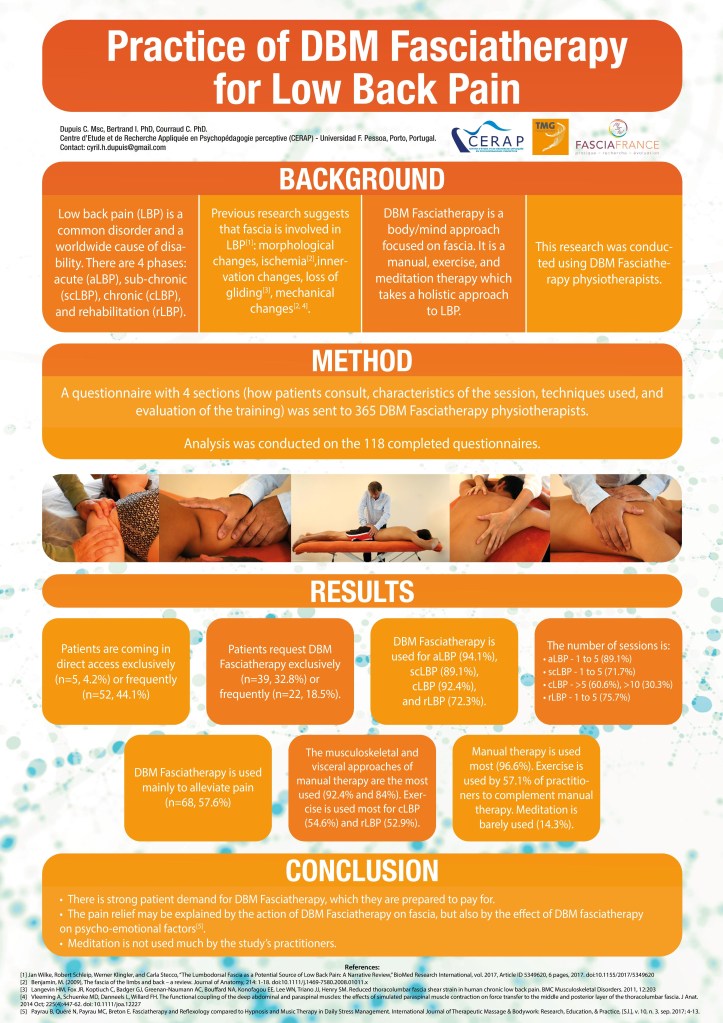
Les lombalgies communes constituent une des consultations les plus fréquentes chez le masseur-kinésithérapeute. Toutefois, la faiblesse des recommandations en France ne permet pas aux masseurs-kinésithérapeutes d’avoir une orientation claire concernant la prise en charge de cette pathologie et l’efficacité de la kinésithérapie dans ce domaine n’a malheureusement pas encore été démontrée [1]. Il existe par ailleurs peu de preuves démontrant la supériorité d’une prise en charge par rapport à une autre, sans doute en raison du caractère complexe de la lombalgie. Dans ce contexte, on assiste au développement de nouveaux modèles de classification et de prise en charge des patients lombalgiques, ancrées dans un modèle bio-psycho-social et incitant à une approche plus globale du patient.
Des études récentes ont mis à jour l’implication du fascia dans les mécanismes de la lombalgie et suggèrent que le recours à des techniques thérapeutiques ciblées sur ce tissu constitue une voie de recherche pour améliorer la qualité de la prise en charge des patients lombalgiques. Cette enquête, menée auprès d’une population de masseurs-kinésithérapeutes formés à la fasciathérapie, a pour objectif d’évaluer de quelle manière et sur quels aspects cette approche est appliquée dans la prise en charge de la lombalgie. Les résultats indiquent que la fasciathérapie semble être une thérapeutique favorisant l’amélioration de la prise en charge de la lombalgie en masso-kinésithérapie. Elle est utilisée à toutes les phases de la lombalgie, principalement pour son action antalgique. Les masseurs-kinésithérapeutes formés à la fasciathérapie se considèrent comme bien préparés à la prise en charge de cette pathologie. Toutefois, ils utilisent de façon prioritaire la thérapie manuelle et sous-utilisent la gymnastique sensorielle ou encore la méditation et l’entretien verbal, qui font partie de la fasciathérapie.
Practice of DBM Fasciatherapy for Low Back Pain
Dupuis C., Bertrand I., Courraud C.
CERAP, Universidad F. Pessoa, Porto, Portugal.
Introduction
Low Back Pain (LBP) is a common disorder and a worldwide cause of disability. There are 4 phases: acute (aLBP), sub-chronic (scLBP), chronic (cLBP), and rehabilitation (rLBP).
Previous research has suggested that fascia is involved in LBP. Morphological changes, ischemia, innervation changes, loss of gliding, and mechanical changes have been studied.
DBM Fasciatherapy is a body/mind approach focused on fascia. It is a manual, exercise, and meditation therapy which takes a holistic approach to LBP.
Evidence Based Practice is an approach for optimizing decision-making, which has three principles: research evidence, clinical expertise, client preference.
In France, a study (AFREK, 2009) showed that the number of physiotherapy session was 13 for aLBP, and 20 for cLBP.
Purpose/Aim
This study aimed to evaluate the use of DBM Fasciatherapy by members of FasciaFrance, the French association of professional practicing this method.
Materials and Methods
The research was conducted with physiotherapists using DBM Fasciatherapy.
A questionnaire about DBM Fasciatherapy was sent to 365 practitioners. It contained 4 sections: How patients consult, Characteristics of the session, Techniques used, Evaluation of the training.
The 118 completed questionnaires were analyzed.
Results
Practitioners had a mean of 44 (σ=30) patients a week, including 16 (σ=18) LBP patients.
They saw LBP patients in direct access exclusively (n=5, 4%) or mainly (n=52, 44%).
Patients requested DBM Fasciatherapy exclusively (n=39, 33%) or mainly (n=22, 19%). 72% of patients (n=85) never requested a different therapy.
DBM Fasciatherapy was used for aLBP (94%), scLBP (89%), cLBP (92%), and rLBP (72%). The number of sessions was:
- aLBP: 1 to 5 (89%)
- scLBP: 1 to 5 (72%)
- cLBP: >5 (61%), >10 (30%)
- rLBP: 1 to 5 (76%)
Fasciatherapy was used mainly to alleviate pain (n=68, 58%); more for aLBP (n=39, 35%) or scLBP (30%) than for cLBP (19%) or rLBP (16%).
Manual therapy was used most (97%). Exercise was used by 57% of practitioners to complement manual therapy. It was used most for cLBP (n=65, 55%) and rLBP (n=63, 53%).
Meditation was not used much (14%).
The musculoskeletal and visceral approaches of manual therapy were the most used (92% and 84%). Exercise was used most for cLBP (55%) and rLBP (53%).
Conclusion
This study gives an insight into the clinical use of DBM Fasciatherapy. Practitioners were experienced with LBP patients. There is a demand for DBM Fasciatherapy, which patients are prepared to pay for – consequence of direct access in France. DBM Fasciatherapy is used at every phase of LBP, and the number of sessions is relatively small compared with physiotherapy alone. The manual approach is used most in every phase, exercise therapy is used most for chronic situations. Even if meditation has been shown to be effective in the literature, it is not used much by the study’s practitioners.
The pain relief reported may be explained by the action of DBM Fasciatherapy on fascia, but also by the effect of DBM Fasciatherapy on psycho-emotional factors.
Keywords: DBM Fasciatherapy, Low Back Pain, Evidence Based Practice, Fascia, clinical practice