Christian Courraud, PT, PhD, CERAP/UFP
Cyril Dupuis, PT, MSc, CERAP/UFP
Isabelle Bertrand, PT, PhD, CERAP/UFP
Introduction
Fascia is richly endowed with sensory nerve endings, including nociceptors. The study of the fascial system is of increasing interest to researchers and clinicians. The aim of this study is to explore how physiotherapists integrate DBM Fasciatherapy into their daily practice and whether it contributes to pain management.
Methods
This study surveyed 446 physiotherapists trained in DBM Fasciatherapy. An online survey was conducted using a customized, non-validated questionnaire.
The questionnaire had two closed questions to evaluate respondents’ opinion of improvements and the therapy’s effectiveness in the reduction of physical and mental pain.
The questionnaire also had two open questions about which type(s) of pain were reduced. Respondents were able to give a maximum of six responses and were able to answer “none”.
Results
A total of 238 fully completed forms were analyzed.
The DBM Fasciatherapists expressed a strong belief in the effectiveness of the therapy for both physical pain (n = 228, 95.8%) and mental suffering (n = 200, 84%). They mainly reported an important (or significant) improvement (Table 1) in physical pain (n = 144, 60%). However, a significant number of them reported seeing a very important improvement in mental suffering (n = 95, 40%).
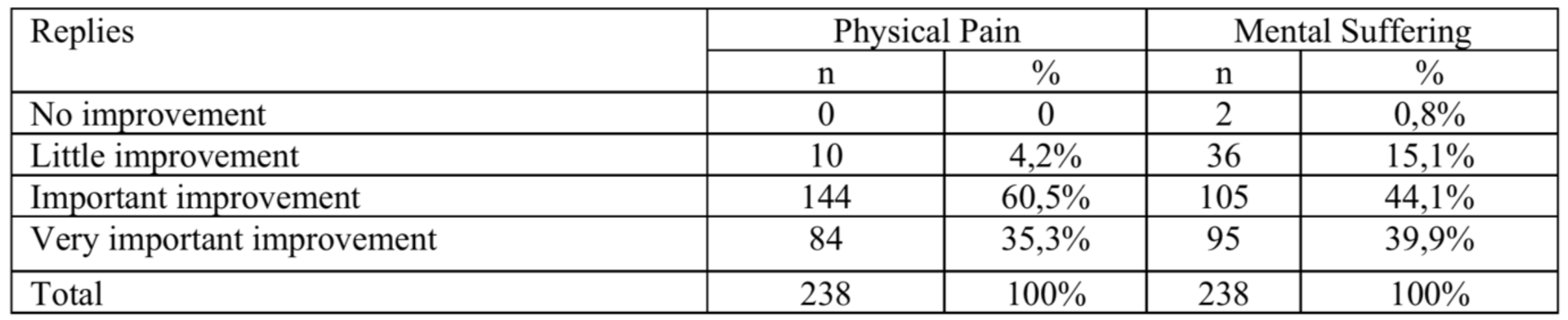
All respondents indicated having noticed an improvement in at least one pathology. A total of 51.5% (n = 129) of them reported a lack of improvement in at least one condition. Around 46% (n = 109) of respondents can be estimated to have achieved an improvement in all the pathologies they faced in their daily practice.
The respondents saw the most improvement in headaches (n = 110, 46.2%), neck pain (n = 82, 34.5%), acute low back pain (n= 76, 31.9%), chronic low back pain (n = 47, 19.7%), and migraines (n = 37, 15.5%).
Conclusion
From the perspective of the physiotherapists, this approach fits into and improves their practice through its joint action on physical pain and psychological suffering and through alternative ways of managing musculoskeletal pain. Other studies comparing this approach with other manual therapy techniques or fascia therapies would be necessary to identify its specific benefits.